

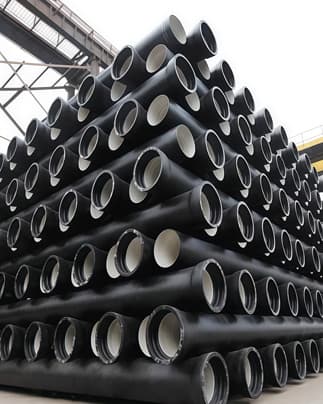
Socket-and-Spigot Joint DI Pipes: Flexible Push-On Jointing for Seismic & Trench Infrastructure
Socket-and-Spigot (Push-on Tyton) Joint Ductile Iron Pipes represent the worldwide standard for underground pressurized water transmission and sewer force mains conforming to IS 8329, ISO 2531, and BS EN 545 specifications.
Engineered with an integral bell socket on one end and a chamfered spigot barrel on the other, the joint accommodates an elastomeric sealing gasket (EPDM, SBR, or NBR). When the spigot is pushed into the socket, the rubber gasket compresses radially within an internal annular groove, creating an instantly watertight, self-energizing seal under both internal operating pressure and external groundwater head.
The inherent brilliance of socket-and-spigot flexible joints lies in their ability to absorb ground settlement, soil movement, vehicular traffic vibrations, and seismic tremors without leakage. With permissible angular deflection ranging between 1.5° to 5° per joint and longitudinal thermal breathing room, push-on joint DI pipelines can be curved naturally along road contours without requiring excessive specialized pipe bends.
Advantages of Socket-and-Spigot Joint DI Pipes
Engineered for maximum operational reliability, high structural integrity, and economic efficiency across challenging applications.
Angular Deflection (1.5° to 5°)
Allows natural trench curvature and contouring around existing underground utilities without requiring fabricated fittings or elbow components.
Rapid Push-On Installation
No welding, bolt torquing, or specialized hot-work equipment required. A simple mechanical pulling jack or excavator bucket easily homes the joint in minutes.
Seismic & Settlement Resilience
Elastomeric joint absorbs differential ground settlements, road vibration under heavy highway axle loads, and seismic tremors without joint slippage or fracture.
Self-Energizing Dual Hardness Gasket
EPDM/NBR gaskets feature a hard heel for positive retention in the socket groove and a soft bulb that expands tighter as water pressure rises.
Working Pressures Up to 64 Bar
Rated for test pressures up to 1.5 times working pressure, providing bulletproof security against transient hydraulic water hammer and surge spikes.
Longitudinal Axial Expansion
Accommodates cyclic thermal contraction and expansion within the socket cavity, preventing axial pipeline buckling under shifting seasonal temperatures.
Types of Socket-and-Spigot Joint Pipes
Push-on flexible joint systems with EPDM/NBR elastomeric gaskets offering fast field jointing and angular deflection to withstand ground settlement.
Push-On Tyton Flexible Joint DI Pipes
Self-Anchoring Restrained Joint DI Pipes
High-Deflection Extended Socket Pipes
Mechanical Joint (MJ) Bolted Socket Pipes
Technical Specifications & Standards
Strictly complying with Bureau of Indian Standards IS 8329, ISO 2531, and BS EN 545 for flexible push-on jointing systems.
| Applicable Standards | IS 8329, ISO 2531, BS EN 545, AWWA C151 / C111, EN 598 |
| Nominal Diameters (DN) | DN 80 mm to DN 2200 mm (Standard lengths: 5.5m & 6.0m effective length) |
| Pressure Class Classifications | Class K7, K9, K10, K12 and Class C25, C30, C40, C50 (Up to 64 bar hydrostatic) |
| Joint Types | Push-on Flexible (Tyton® type), Restrained / Anchored (Tyton-Sit), Mechanical Joint (MJ) |
| Gasket Materials | EPDM (Potable water certified to EN 681-1 / IS 5382), NBR (Hydrocarbons & sewage), SBR |
| Allowable Angular Deflection | DN 80–300: up to 5° | DN 350–600: up to 4° | DN 700–1000: up to 3° | DN 1200+: 1.5° to 2° |
| Internal Lining | Centrifugal Portland / Sulfate Resistant / High-Alumina cement mortar (IS 8329) |
| External Protective Coating | Metallic zinc spray (min 200 g/m²) + Bituminous varnish (min 70 µm) or Polyurethane |
| Spigot Chamfer | Precision machined bevel (15° to 20°) for smooth gasket engagement without displacement |
| Hydrostatic Factory Test | 100% pipes hydro-tested at factory (32 to 50 bar depending on DN and Class) |
Major Industrial Applications
The proven gold standard for municipal water grids, long-distance transmission, and irrigation command works:
Cross-Country Water Transmission
Long-distance regional bulk drinking water trunk pipelines crossing varied topography, hills, valleys, and rural terrains.
Municipal Distribution Grids
City water distribution networks running beneath congested roads, pavements, and vehicular traffic corridors subject to dynamic wheel loads.
High-Pressure Lift Irrigation
Pressurized canal feeding lines and micro-irrigation feeder pipelines supplying water to agricultural commanding areas.
Seismic & Subsidence Prone Zones
Reclaimed land, marshy soils, bridge abutment approaches, and earthquake zones where rigid piping would fracture under differential settlement.
Raw & Treated Water Pumping Mains
High-volume transmission lines connecting river intake structures to city reservoirs and water filtration facilities.
Highway & Railway Under-Crossings
Heavy-traffic arterial pipeline crossings where socket flexibility absorbs perpetual dynamic impact and soil deflection.
Why Choose Apex Engineering for Socket-and-Spigot Joint Pipes?
In severe service networks, choosing a certified manufacturer guarantees precise tolerances and complete reliability for Socket-and-Spigot Joint Pipes.
Angular Deflection (1.5° to 5°)
Allows natural trench curvature and contouring around existing underground utilities without requiring fabricated fittings or elbow components.
Rapid Push-On Installation
No welding, bolt torquing, or specialized hot-work equipment required. A simple mechanical pulling jack or excavator bucket easily homes the joint in minutes.
Seismic & Settlement Resilience
Elastomeric joint absorbs differential ground settlements, road vibration under heavy highway axle loads, and seismic tremors without joint slippage or fracture.
Self-Energizing Dual Hardness Gasket
EPDM/NBR gaskets feature a hard heel for positive retention in the socket groove and a soft bulb that expands tighter as water pressure rises.
Working Pressures Up to 64 Bar
Rated for test pressures up to 1.5 times working pressure, providing bulletproof security against transient hydraulic water hammer and surge spikes.
Longitudinal Axial Expansion
Accommodates cyclic thermal contraction and expansion within the socket cavity, preventing axial pipeline buckling under shifting seasonal temperatures.
Frequently Asked Questions
Key questions and answers regarding Socket-and-Spigot DI Pipes, Tyton gaskets, and angular deflection.
The socket has an internal retaining groove engineered to lock an elastomeric rubber gasket (Tyton type). As the chamfered spigot of the adjoining pipe is pushed into the socket, the gasket is radially compressed between the spigot outer diameter and the socket inner wall. As internal hydrostatic pressure rises, water pressure energizes the rubber bulb, pressing it tighter against the sealing walls to create a leak-proof barrier.
Sourcing Socket-and-Spigot Joint DI Pipes for Water or Irrigation Projects?
Speak directly with our technical piping engineers for project-specific sizing (DN 80 to DN 2200), Class K7 / K9 availability, EPDM Tyton gaskets, and factory dispatch timelines.