

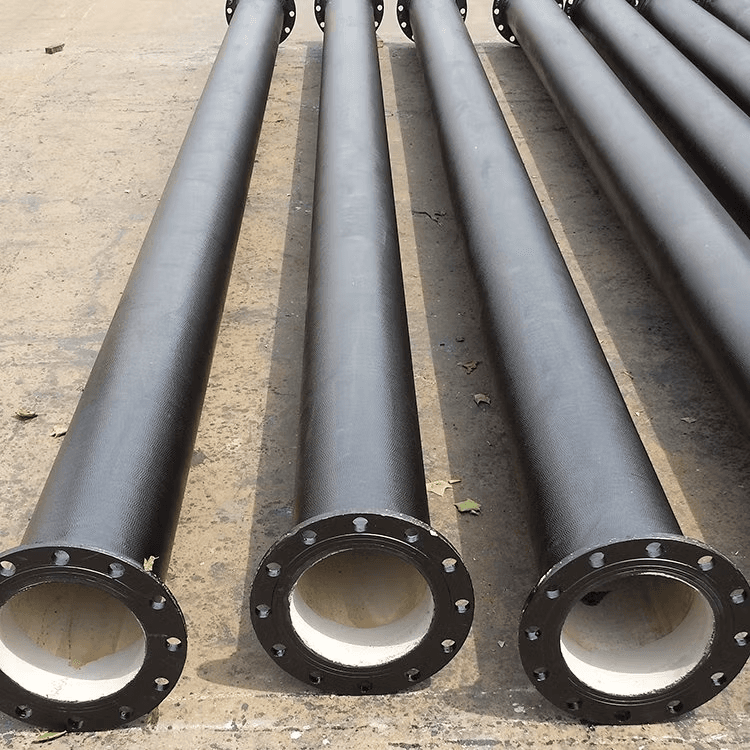
Cement Mortar Lined DI Pipes: Smooth Hydraulic Potable Water Transmission Piping
Cement Mortar Lined (CML) Ductile Iron Pipes are manufactured by centrifugally applying a dense, high-strength cement mortar lining across the internal bore of centrifugally cast spheroidal graphite (ductile) iron pipes conforming to IS 8329, ISO 2531, and EN 545.
During centrifugal lining, wet cement slurry (using Sulphate Resistant Cement, Blast Furnace Slag Cement, or High-Alumina Cement) is sprayed into the rapidly spinning pipe. The intense centrifugal force expels excess water and compacts the mortar into an exceptionally dense, smooth cylindrical stone lining with a Hazen-Williams hydraulic flow coefficient of C = 140 to 150, which never decreases over decades of operation.
This cement mortar lining provides active chemical passivation: when water enters the pipe, an alkaline calcium hydroxide environment (pH > 12) is established at the iron-cement interface, forming a self-healing passivation barrier that completely prevents internal rust tuberculation, eliminates pumping energy losses, and guarantees clean, hygienic drinking water delivery for 100+ years.
Advantages of Cement Mortar Lined DI Pipes
Engineered for maximum operational reliability, high structural integrity, and economic efficiency across challenging applications.
Active Alkaline Chemical Passivation
Hydrated cement maintains an alkaline pore solution (pH 12.5), creating a self-passivating iron oxide film that arrests internal corrosion.
Permanent High Flow Coefficient (C = 140)
Ultra-smooth centrifugal compaction eliminates frictional head loss and tuberculation, reducing pump electricity costs by up to 25%.
High Tensile Strength (≥ 420 MPa)
Spheroidal nodular graphite gives ductile iron twice the tensile strength of grey iron and substantial elongation (≥ 10%) against ground movement.
Self-Healing Microcrack Autogenous Healing
Minor hairline drying shrinkage cracks heal naturally upon immersion in water as unhydrated cement particles react to form calcium carbonate.
High Water Hammer Surge Resistance
Ductile iron walls easily absorb transient pressure spikes up to twice the nominal working pressure without brittle failure.
100% Factory Hydrostatic Proof Testing
Every pipe length is hydrostatically proof tested at the mill (up to 50 bar for Class K9) and verified for lining thickness and adhesion.
Types of Cement Mortar Lined DI Pipes
Internally lined with centrifugal Portland or high-alumina cement mortar to maintain smooth hydraulic flow, prevent tuberculation, and safeguard drinking water quality.
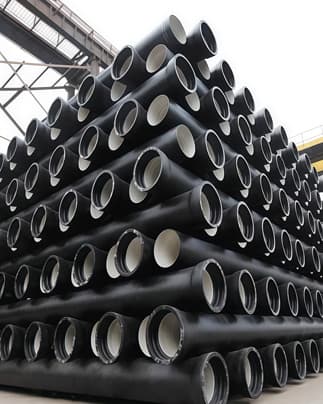
IS 8329 Class K7 & K9 Water Transmission DI Pipes
Blast Furnace Slag Cement (BFSC) Lined Pipes
High-Alumina Cement (HAC) Lined DI Pipes
External Zinc & Bitumen Coated CML DI Pipes
Technical Specifications & Standards
Cement mortar lined ductile iron pipes adhere strictly to Bureau of Indian Standards (BIS) IS 8329 and international ISO 2531 specifications.
| Nominal Diameters (DN) | DN 80 mm up to DN 2200 mm (3" to 88") in centrifugally cast ductile iron executions |
| Pressure Classes | Class K7, Class K9, Class K10, Class K12; Class C25, Class C30, Class C40 per ISO 2531 / EN 545 |
| Governing Standards | IS 8329, ISO 2531, EN 545 (Potable Water), BS EN 545, AWWA C151 / C104 |
| Internal Cement Lining Types | Portland Slag Cement (PSC), Blast Furnace Slag Cement (BFSC), or High-Alumina Cement (HAC) |
| Lining Thickness Range | 3.0 mm (DN 80) up to 9.0 mm (DN 2200) according to IS 8329 Table 3 |
| External Protective Coatings | Metallic zinc spray (min 200 g/m²) conforming to ISO 8179-1 + Bituminous varnish or blue epoxy topcoat (min 70 microns) |
| Jointing Systems | Push-on flexible joint (Tyton type with EPDM / SBR rubber gasket per IS 5382); Restrained self-anchoring joints |
| Mechanical Properties | Tensile Strength: ≥ 420 MPa | Yield Strength (0.2%): ≥ 300 MPa | Elongation: ≥ 10% | Hardness: ≤ 230 HB |
| Mandatory Quality Tests | 100% Hydrostatic proof pressure test (up to 5.0 MPa), Lining adhesion test, Zinc mass test, Tensile bar test |
Major Industrial Applications
The globally trusted backbone for municipal drinking water supply and bulk lift irrigation schemes:
Municipal Drinking Water Transmission
Regional bulk water transmission mains, clear water pump station discharge lines, and municipal distribution grids.
River Lift Irrigation Trunk Networks
High-volume agricultural irrigation distribution, canal siphon crossings, and pressurized command area pipelines.
Water Treatment Plant (WTP) Inlets
Raw water intake headers, clarifier piping loops, filter wash discharge lines, and pure water gravity mains.
Industrial Plant Process Water Mains
Steel plant circulating cooling water headers, thermal power plant makeup lines, and chemical plant utility loops.
Cross-Country Pipeline Projects
Inter-district bulk water supply schemes, national water grid pipelines, and reservoir interconnects.
Fire Water Ring Mains & Standpipes
Underground high-pressure industrial fire hydrant networks, refinery water rings, and port terminal fire loops.
Why Choose Apex Engineering for Cement Mortar Lined DI Pipes?
In severe service networks, choosing a certified manufacturer guarantees precise tolerances and complete reliability for Cement Mortar Lined DI Pipes.
Active Alkaline Chemical Passivation
Hydrated cement maintains an alkaline pore solution (pH 12.5), creating a self-passivating iron oxide film that arrests internal corrosion.
Permanent High Flow Coefficient (C = 140)
Ultra-smooth centrifugal compaction eliminates frictional head loss and tuberculation, reducing pump electricity costs by up to 25%.
High Tensile Strength (≥ 420 MPa)
Spheroidal nodular graphite gives ductile iron twice the tensile strength of grey iron and substantial elongation (≥ 10%) against ground movement.
Self-Healing Microcrack Autogenous Healing
Minor hairline drying shrinkage cracks heal naturally upon immersion in water as unhydrated cement particles react to form calcium carbonate.
High Water Hammer Surge Resistance
Ductile iron walls easily absorb transient pressure spikes up to twice the nominal working pressure without brittle failure.
100% Factory Hydrostatic Proof Testing
Every pipe length is hydrostatically proof tested at the mill (up to 50 bar for Class K9) and verified for lining thickness and adhesion.
Frequently Asked Questions
Key questions and answers regarding Cement Mortar Lined DI Pipes, IS 8329 classes, and autogenous healing.
Unlined ferrous pipes are prone to internal tuberculation—the buildup of iron oxide mounds caused by water chemistry—which restricts pipe diameter and increases pumping friction over time. Centrifugally compacted cement mortar creates an active alkaline environment (pH > 12) that prevents internal rusting, prevents tuberculation completely, and maintains a smooth Hazen-Williams C=140 flow coefficient for the entire 100-year design life.
Looking for Cement Mortar Lined DI Pipes for Your Water Transmission Project?
Contact our municipal infrastructure engineering team with your required nominal diameter (DN 80 to DN 2200), class (K7/K9), gasket specifications, and site delivery schedule for immediate project estimates.