

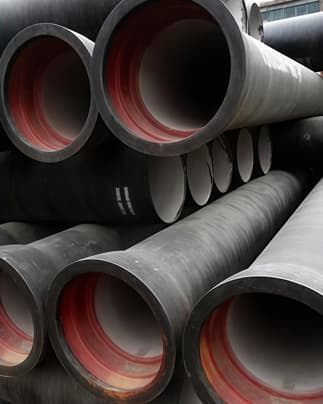
Hub-and-Spigot Cast Iron Pipes: Flexible Socketed Underground Drainage Piping
Hub-and-Spigot Cast Iron Pipes (commonly known as Bell-and-Spigot or Socket-and-Spigot CI Pipes) feature an enlarged bell or hub formed integrally at one end and a plain beveled spigot at the opposite end, designed to interlock and form a flexible, leak-tight subterranean joint.
Specifically engineered for buried sanitary sewer lines, municipal stormwater trunks, and vertical building drainage risers, the hub-and-spigot jointing configuration accommodates minor ground settlement, differential soil expansion, and thermal cyclic movement without placing bending stress on the pipe body or breaking the hydraulic seal.
Manufactured in compliance with IS 3989, IS 1536, BS 416, and ASTM A74 (Service and Extra Heavy classes), our hub-and-spigot pipes can be joined using modern elastomeric neoprene compression gaskets (Tyton push-on type) for rapid trench installation or traditional molten lead and caulked oakum packing for historical municipal restorations, providing superior crush strength, non-combustibility, and 100+ years of operational durability.
Advantages of Hub-and-Spigot Cast Iron Pipes
Engineered for maximum operational reliability, high structural integrity, and economic efficiency across challenging applications.
Flexible Joint Accommodates Ground Settlement
The bell-and-spigot geometry permits up to 3° to 5° of angular deflection at each joint, preventing pipe shear during seismic or soil shifts.
Push-On Elastomeric Gasket Assembly
Neoprene compression gaskets allow instant, all-weather jointing without requiring electrical power, open torches, or solvent cements.
Zero Deflection Under Heavy Earth Overburden
High structural modulus and rigid cast iron wall eliminate cross-sectional ovalization under deep soil burial and rolling wheel loads.
Natural Root Penetration Barrier
Tightly compressed neoprene or lead-caulked hub joints physically prevent tree root intrusion, eliminating the main cause of sewer blockages.
Acoustically Silent Fluid Flow
Dense graphite flake matrix damps out water rushing noise, keeping high-rise drainage and hospital sanitary stacks quiet.
Certified 100-Year Subterranean Lifespan
Proven municipal track record of 100+ years in active service without degrading under sewer hydrogen sulfide or soil moisture.
Types of Hub-and-Spigot CI Pipes
Traditional socket-and-spigot design sealed with elastomeric gaskets or lead joints for flexible, leak-tight underground drainage lines.
IS 3989 Socket & Spigot Soil & Vent Pipes
ASTM A74 Extra Heavy (XH) Bell-and-Spigot Pipes
Elastomeric Gasket Push-On CI Pipes
Caulked Lead-and-Oakum Hubbed CI Pipes
Technical Specifications & Standards
Manufactured to IS 3989, IS 1536, and ASTM A74 specifications with verified joint deflection and hydrostatic test compliance.
| Nominal Diameters (DN) | 50 mm (2") up to 600 mm (24") in standard socket-and-spigot spun executions |
| Classification Grades | Class LA, Class A, and Class B (IS 1536 / IS 3989); Service (SV) & Extra Heavy (XH) (ASTM A74) |
| Manufacturing Standards | IS 3989, IS 1536, ASTM A74, BS 416, BS 437, DIN 19522 |
| Jointing Methods | Push-on elastomeric rubber compression gasket (EPDM/Neoprene per IS 5382), or Traditional Molten Lead & Oakum |
| Permissible Joint Deflection | Up to 3° to 5° angular deflection per joint without loss of water tightness |
| Standard Laid Lengths | Standard 3.0 m, 4.0 m, and 5.5 m effective laid lengths (excluding hub depth) |
| Internal & External Coatings | Internal asphaltic bituminous solution or cement mortar; External black rust-preventive varnish |
| Mechanical Properties | Tensile Strength: ≥ 150 to 200 MPa; Compressive Strength: > 600 MPa; Brinell Hardness: ≤ 230 HB |
| Quality & Proof Testing | 100% Hydrostatic proof pressure testing, Joint deflection leak testing, Ring crush testing |
Major Industrial Applications
The infrastructure choice for subterranean municipal sewer mains and building gravity stacks:
Municipal Buried Sanitary Sewers
Underground gravity sewer mains, trunk sewer laterals, and municipal wastewater collector systems.
Building Vertical Drainage Risers
Multi-story residential and commercial SWR stacks, vent lines, and rainwater downspouts.
Highway & Runway Culvert Interconnects
Heavy-duty storm water runoff conduits beneath highway subgrades, runways, and railway tracks.
Heritage & Institutional Plumbing
Historic government buildings, university campuses, and municipal infrastructure restorations.
Hospital & Healthcare Waste Stacks
Acoustically damped drainage lines for operating theaters, intensive care units, and wards.
Industrial Plant Stormwater & Sump Lines
Factory stormwater collection networks, boiler blowdown drains, and floor sump interconnects.
Why Choose Apex Engineering for Hub-and-Spigot CI Pipes?
In severe service networks, choosing a certified manufacturer guarantees precise tolerances and complete reliability for Hub-and-Spigot CI Pipes.
Flexible Joint Accommodates Ground Settlement
The bell-and-spigot geometry permits up to 3° to 5° of angular deflection at each joint, preventing pipe shear during seismic or soil shifts.
Push-On Elastomeric Gasket Assembly
Neoprene compression gaskets allow instant, all-weather jointing without requiring electrical power, open torches, or solvent cements.
Zero Deflection Under Heavy Earth Overburden
High structural modulus and rigid cast iron wall eliminate cross-sectional ovalization under deep soil burial and rolling wheel loads.
Natural Root Penetration Barrier
Tightly compressed neoprene or lead-caulked hub joints physically prevent tree root intrusion, eliminating the main cause of sewer blockages.
Acoustically Silent Fluid Flow
Dense graphite flake matrix damps out water rushing noise, keeping high-rise drainage and hospital sanitary stacks quiet.
Certified 100-Year Subterranean Lifespan
Proven municipal track record of 100+ years in active service without degrading under sewer hydrogen sulfide or soil moisture.
Frequently Asked Questions
Key questions and answers regarding Hub-and-Spigot Cast Iron Pipes, neoprene compression gaskets, and ground deflection.
The spigot end of the pipe inserts into the enlarged hub cavity cushioned by an elastomeric compression gasket. Because the joint relies on radial compression rather than a rigid cement bond, it allows minor axial expansion and up to 3° to 5° of angular deflection without breaking the seal, absorbing soil settlement without cracking the pipe.
Looking for Hub-and-Spigot Cast Iron Pipes for Your Sewer Line?
Contact our civil sales engineers with your required pipe size (DN 50 to DN 600), class (Service / Extra Heavy), gasket accessories, and project schedule for immediate mill quotations.