

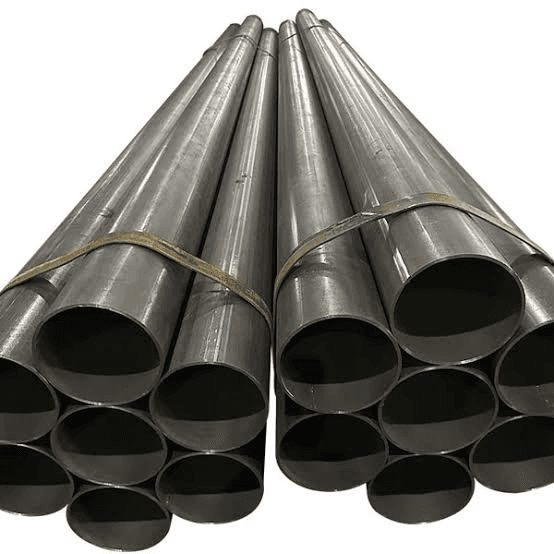
ERW Carbon Steel Pipes: High-Frequency Welded Precision Piping Solutions
ERW (Electric Resistance Welded) carbon steel pipes are manufactured by cold-forming premium hot-rolled carbon steel coils into tubular cylindrical shapes and welding the longitudinal seam continuously using high-frequency electric resistance without the addition of filler metal.
The resulting weld seam undergoes online post-weld induction heat treatment (seam annealing) to normalize the grain microstructure, matching the tensile strength, ductility, and toughness of the parent pipe body. This makes ERW pipes exceptionally reliable for fluid conveyance, structural applications, and industrial utility headers.
Manufactured in strict adherence to ASTM A53 Grade B, IS 1239, IS 3589, and API 5L (PSL 1 & PSL 2), our ERW carbon steel pipes offer tight dimensional tolerances, smooth surface finishes, and substantial cost savings compared to seamless pipe alternatives.
Advantages of ERW Carbon Steel Pipes
Engineered for maximum operational reliability, high structural integrity, and economic efficiency across challenging applications.
Tight Dimensional Tolerances
Continuous cold-roll forming guarantees superior circularity, strict outer diameter control, and uniform wall thickness across every meter.
Full-Body & Seam Heat Treatment
High-frequency seam annealing eliminates martensitic brittleness, ensuring the weld seam shares identical toughness with the base metal.
Cost-Effective High Performance
Provides an economical balance of high burst-pressure performance and budget efficiency compared to seamless piping.
Smooth Internal & External Bore
Internal and external weld bead trimming (flash removal) ensures unrestricted fluid flow with low hydraulic friction coefficients.
Wide Size & Thickness Range
Available from 1/2" NB up to 24" NB with wall thicknesses ranging from SCH 10 to SCH 80 and custom light-to-heavy gauges.
Rigorous 100% NDT Testing
Every millimeter of the longitudinal weld is inspected using online ultrasonic flaw detection and factory hydrostatic testing.
Types of ERW Carbon Steel Pipes
Engineered for maximum reliability across commercial plumbing, oilfield transmission, and heavy structural engineering.
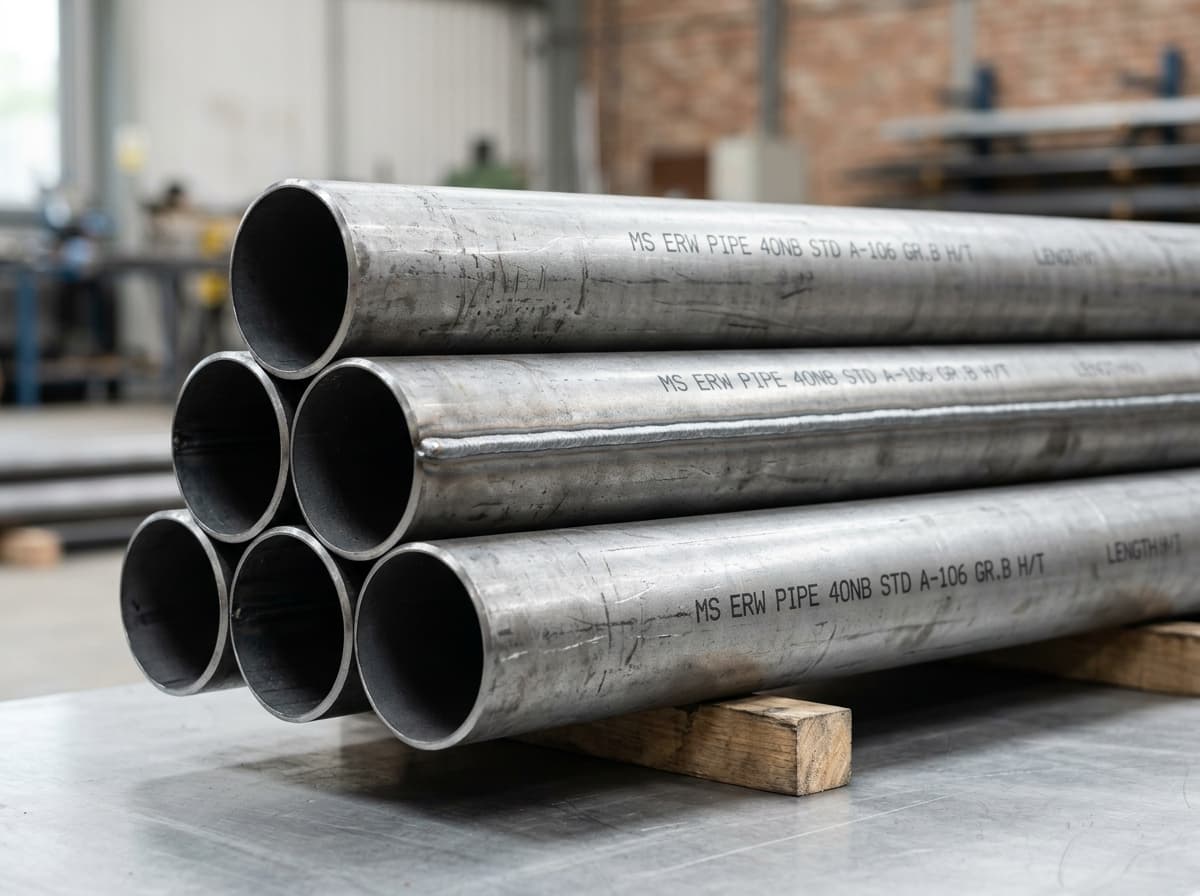
IS 1239 / IS 3589 Water & Gas ERW Pipes
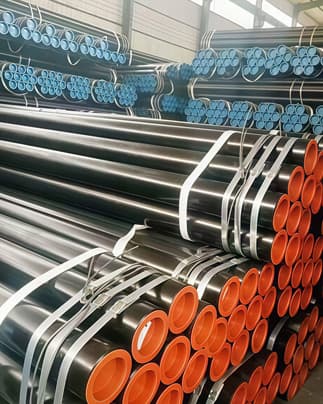
ASTM A53 Grade B ERW Industrial Pipes
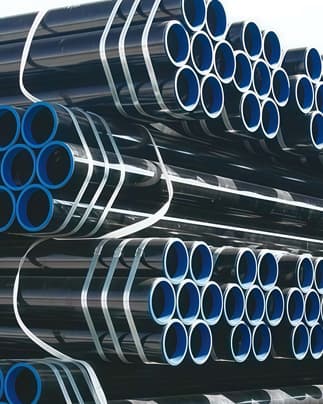
API 5L ERW Line Pipes (Gr. B to X65)
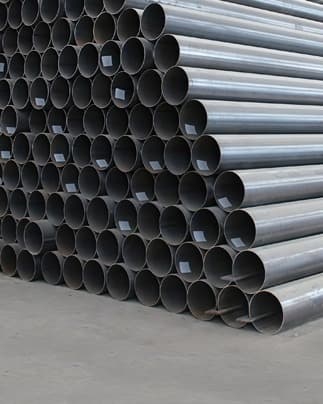
Structural Hollow Sections & ERW Columns
Technical Specifications & Standards
ERW carbon steel pipes are available in diverse pressure ratings, schedules, and certified international specifications.
| Applicable Standards | IS 1239 (Part 1), IS 3589, ASTM A53 Type E (Gr. A & B), API 5L (PSL 1 & PSL 2), BS 1387, EN 10255 |
| Material Grades | Fe 330, Fe 410, ASTM A53 Gr. B, API 5L Grade B, X42, X46, X52, X56, X60, X65 |
| Nominal Diameters | 1/2" NB (15mm) to 24" NB (600mm) in high-frequency electric resistance welded |
| Wall Thickness Range | Light, Medium, Heavy Class per IS 1239; SCH 10, SCH 20, SCH 40, SCH 80; 2.0mm to 16.0mm |
| End Configurations | Plain End (PE), Square Cut, Beveled End (BE 30° / 37.5° for butt welding), Threaded & Coupled (IS 554 / BSPT) |
| Surface Finish & Coatings | Self-color black mill varnish, anti-rust oiling, Hot-Dip Galvanized (GI), 3LPE, and red oxide primer |
| Weld Condition | Online high-frequency induction seam annealed with internal & external weld bead trimmed flush |
| Mandatory Quality Tests | 100% Hydrostatic pressure testing, Online Eddy Current / Ultrasonic weld inspection, Flattening, Bend test, Tensile & MTC EN 10204 3.1 |
Major Industrial Applications
ERW carbon steel pipes are widely deployed across water infrastructure, hydrocarbon transmission, and industrial engineering:
Fire Fighting & Sprinkler Systems
High-reliability pressurized water distribution mains and indoor sprinkler riser pipes.
HVAC Chilled & Cooling Water Lines
Condenser water loops, cooling tower supply risers, and central air conditioning lines.
Oil & Gas Gathering Networks
Onshore gathering lines, low-to-medium pressure natural gas feeds, and terminal pipelines.
Water Supply & Plumbing Infrastructure
Potable municipal water distribution, borewell casing, and agricultural irrigation grids.
Industrial Plant Process Piping
Compressed air ring mains, non-corrosive chemical transport, and general utility headers.
Structural Engineering & Civil Works
Architectural tubular trusses, highway sign gantries, bridge railings, and structural piling.
Why Choose Apex Engineering for ERW Carbon Steel Pipes?
In severe service networks, choosing a certified manufacturer guarantees precise tolerances and complete reliability for ERW Carbon Steel Pipes.
Tight Dimensional Tolerances
Continuous cold-roll forming guarantees superior circularity, strict outer diameter control, and uniform wall thickness across every meter.
Full-Body & Seam Heat Treatment
High-frequency seam annealing eliminates martensitic brittleness, ensuring the weld seam shares identical toughness with the base metal.
Cost-Effective High Performance
Provides an economical balance of high burst-pressure performance and budget efficiency compared to seamless piping.
Smooth Internal & External Bore
Internal and external weld bead trimming (flash removal) ensures unrestricted fluid flow with low hydraulic friction coefficients.
Wide Size & Thickness Range
Available from 1/2" NB up to 24" NB with wall thicknesses ranging from SCH 10 to SCH 80 and custom light-to-heavy gauges.
Rigorous 100% NDT Testing
Every millimeter of the longitudinal weld is inspected using online ultrasonic flaw detection and factory hydrostatic testing.
Frequently Asked Questions
Key questions and answers regarding ERW Carbon Steel Pipes, high-frequency welding processes, and standards compliance.
ERW (Electric Resistance Welded) pipe is produced by passing a flat steel coil through forming rolls to shape it into a cylinder. High-frequency electrical current (typically 400–500 kHz) is applied to the adjacent edges, heating them to forging temperature without filler wire, and squeeze rolls fuse them together into a monolithic weld seam. The seam is then immediately induction heat-treated to ensure full metallurgical normalization.
Looking for ERW Carbon Steel Pipes for Your Project?
Contact our engineering sales team with your required outer diameter, wall thickness, grade, coating (black / galvanized / 3LPE), and quantity for immediate competitive pricing and rapid dispatch.