

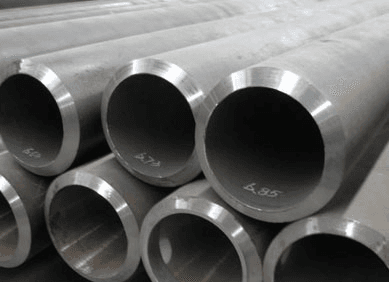
Chrome-Moly Alloy Steel Pipes: High-Creep Thermal Power & Refinery Piping
Chrome-Moly (Chromium-Molybdenum) alloy steel pipes are specialized low-to-medium alloy tubular products engineered specifically to resist the combined degradation mechanisms of high operating temperatures, high mechanical stress, and corrosive process gases such as hydrogen and sulfur.
The metallurgical synergy of Chromium (0.5% to 9.0%) and Molybdenum (0.5% to 1.0%) creates stable, fine carbide precipitates that resist creep-induced grain boundary sliding at temperatures exceeding 540°C (1000°F). In addition, the chromium content establishes an adherent surface oxide film that drastically reduces scaling, hydrogen attack, and graphitization.
Manufactured in compliance with ASTM A335 (seamless) and ASTM A691 (welded) across premier grades P11 (1.25Cr-0.5Mo), P22 (2.25Cr-1Mo), P5 (5Cr-0.5Mo), P9 (9Cr-1Mo), and P91 (9Cr-1Mo-V-Nb), our Chrome-Moly pipes are the primary engineering material for supercritical power boiler loops, desulfurization reactors, and hydrogen reformer transfer lines.
Advantages of Chrome-Moly Alloy Steel Pipes
Engineered for maximum operational reliability, high structural integrity, and economic efficiency across challenging applications.
Exceptional Creep Resistance
Carbide-forming molybdenum stops dislocation movement in steel grains, preventing gradual dimensional elongation under high stress and heat.
Protection Against Hydrogen Attack
Conforms to Nelson Curve limits, preventing methane bubble formation and severe internal fissuring caused by high-temperature, high-pressure hydrogen.
Eliminates Graphitization
Molybdenum and chromium stabilize carbon as iron/chromium carbides, completely eliminating brittle graphite formation that occurs in plain carbon steels above 425°C.
Thin-Wall Weight Reduction
High allowable design stress values enable thinner pipe walls, lowering thermal gradient stresses and reducing structural hanger loads.
Controlled Normalized & Tempered Quality
Precise multi-stage heat treatment ensures maximum toughness, high Charpy impact values, and uniform hardness across the entire pipe.
Certified Mill Traceability
100% heat traceability with EN 10204 3.1 certification, ultrasonic examination, hydrostatic proof test, and spectro chemical verification.
Types of Chrome-Moly Alloy Steel Pipes
High-creep Chromium-Molybdenum alloy pipes engineered for severe high-temperature steam headers, hydrogen reactors, and fired process heaters.
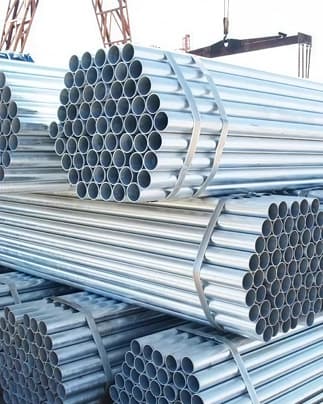
P11 Chrome-Moly Pipes (1.25% Cr - 0.5% Mo)
P22 Chrome-Moly Pipes (2.25% Cr - 1.0% Mo)
P91 Modified Chrome-Moly Pipes (9Cr - 1Mo - V - Nb)
P5 & P9 Intermediate Cr-Mo Pipes
Technical Specifications & Standards
Chrome-Moly alloy steel pipes are available in diverse pressure ratings, schedules, and certified international specifications.
| Applicable Standards | ASTM A335 / ASME SA335, ASTM A691, ASTM A213, DIN 17175, EN 10216-2, BS 3604 |
| Primary Cr-Mo Grades | Grade P11 (UNS K11597), Grade P22 (UNS K21590), Grade P5 (UNS K41545), Grade P9 (UNS K90941), Grade P91 (UNS K91560) |
| Nominal Diameters (NPS) | 1/2" NB to 24" NB (Seamless); 16" NB to 64" NB (Electric-Fusion-Welded EFW) |
| Wall Thickness Schedules | SCH 40, SCH 80, SCH 100, SCH 120, SCH 140, SCH 160, SCH XXS, and custom wall gauges up to 50mm |
| Heat Treatment Condition | Normalized and Tempered (N+T) or Isothermal Annealed with minimum tempering temp per ASTM A335 |
| Pipe End Preparations | Beveled End (BE 37.5° with root face for orbital butt welding), Plain End (PE), Threaded |
| Hardness Limitations | P11/P22: Max 163–217 HBW; P91: Controlled range 196–250 HBW to prevent hard brittle structures |
| Mandatory Quality Tests | 100% Hydrostatic testing, Ultrasonic flaw detection, Longitudinal/Transverse tensile, Hot-tensile test, PMI spectro |
Major Industrial Applications
Chrome-Moly alloy steel pipes provide uncompromised reliability across high-temperature refining and power utilities:
Boiler Superheaters & Reheaters
Steam generator tubing, boiler headers, and main steam lines operating up to 580°C.
Refinery Hydrotreating & Hydrocracking
High-pressure, high-temperature hydrogen reactors, fractionator bottoms, and hot separator loops.
Combined-Cycle Gas Turbine Skids
Heat Recovery Steam Generator (HRSG) high-pressure steam distribution headers.
Fired Process Heaters & Reformers
Furnace convection coils, radiant tubes, and hydrocarbon vapor transfer manifolds.
Petrochemical Chemical Synthesis
High-temperature synthesis gas headers, ammonia reactors, and ethylene cracking lines.
Supercritical Power Plant Mains
Modern supercritical and ultra-supercritical turbine bypass and main steam circuits.
Why Choose Apex Engineering for Chrome-Moly Alloy Steel Pipes?
In severe service networks, choosing a certified manufacturer guarantees precise tolerances and complete reliability for Chrome-Moly Alloy Steel Pipes.
Exceptional Creep Resistance
Carbide-forming molybdenum stops dislocation movement in steel grains, preventing gradual dimensional elongation under high stress and heat.
Protection Against Hydrogen Attack
Conforms to Nelson Curve limits, preventing methane bubble formation and severe internal fissuring caused by high-temperature, high-pressure hydrogen.
Eliminates Graphitization
Molybdenum and chromium stabilize carbon as iron/chromium carbides, completely eliminating brittle graphite formation that occurs in plain carbon steels above 425°C.
Thin-Wall Weight Reduction
High allowable design stress values enable thinner pipe walls, lowering thermal gradient stresses and reducing structural hanger loads.
Controlled Normalized & Tempered Quality
Precise multi-stage heat treatment ensures maximum toughness, high Charpy impact values, and uniform hardness across the entire pipe.
Certified Mill Traceability
100% heat traceability with EN 10204 3.1 certification, ultrasonic examination, hydrostatic proof test, and spectro chemical verification.
Frequently Asked Questions
Key questions and answers regarding Chrome-Moly Alloy Steel Pipes, Nelson curve limits, and welding requirements.
When plain carbon or carbon-molybdenum steels are exposed to temperatures above 425°C (800°F) for extended periods, the iron carbide (Fe3C) can decompose into iron and nodules of free graphite along the grain boundaries. This causes severe localized embrittlement and catastrophic failure. Adding at least 0.5% Chromium stabilizes the carbides permanently, completely preventing graphitization.
Looking for Chrome-Moly Alloy Steel Pipes for Your High-Temperature Facility?
Contact our engineering metallurgy team with your required grade (P11, P22, P91, P5, P9), pipe diameter, schedule wall thickness, end prep, and delivery timeline for competitive mill-direct pricing and technical documentation.